Lone worker protection, answered by a person

About a dollar a day per worker, for local 24/7 Grade A1 professional monitoring

There are thousands of workers already protected by solosafe today.

solosafe is a monitored duress device for people who work on their own. One press connects the worker to a Police licensed operator in our Monitoring Centre in West Perth, who can speak to them, see where they are, and escalate to your nominated contacts or to Police and Ambulance.

Available as a pendant or a watch. From $30 per month per worker, with no minimum term.

Book an obligation-free demonstration — we will come to you, put a device in your team’s hands, and show you exactly what happens when the button is pressed. Call (08) 9427 4800 or request a demo.

Your duty of care, and what it actually requires

Under the Work Health and Safety Act 2020 (WA), a person conducting a business or undertaking must ensure the health and safety of workers so far as is reasonably practicable. The WHS (General) Regulations 2022 (WA) deal with remote or isolated work specifically: you must manage the risks, and you must provide a system of work that includes effective communication with the worker.

Two things about that are worth knowing.

The duty follows the work, not the workplace. “Remote or isolated” means isolated from assistance because of location, time or the nature of the work — and assistance includes rescue, medical help and emergency services. A support worker in a client’s home in Morley is isolated within that meaning. So is a retail worker closing alone, or a nurse on a night visit. It is not only about the Pilbara.

The law requires effective communication, not a particular product. No regulation names a device. What it requires is that you assess the risk, control it proportionately, and document what you did. Where a risk assessment identifies aggression, remoteness or medical risk, a monitored duress device is a common and defensible control — because it produces a response rather than a record.

solosafe gives you that control, and gives you the evidence that you put it in place.

Directors and officers should note that the due diligence duty under the Act is personal and cannot be delegated to the safety team.

How solosafe works

One press, and a person answers

  • Step 1
    The worker presses the button
    One press on the pendant or watch sends an alarm straight to our Monitoring Centre in West Perth. Discreet, with no phone to unlock and no app to open.
  • Step 2
    An operator speaks to them
    A Police licensed operator talks to the worker through the device and assesses what is actually happening — a fall, a medical episode, or someone who has become a problem.
  • Step 3
    Your protocol is followed
    We follow the escalation plan you have set — your nominated contacts, your on-call roster, or straight to Police and Ambulance. The operator stays with it until it is resolved.

Every alert is answered by a Police licensed operator in our own ASIAL Grade A1 Monitoring Centre in West Perth.Answered — not logged for someone to notice later.

What if the worker cannot press the button?

If they cannot speak

Our operator treats it as an emergency, not a false alarm. They use the device’s GPS to confirm the worker’s location and escalate straight to your protocol, with location updating every 30 seconds until it is resolved.

If they cannot reach the button

Fall detection raises the alarm on its own. The worker does not have to be conscious, or able to move, for the alert to reach our Monitoring Centre.

If they are outside coverage

No mobile-network device transmits without a signal, including this one. If you have crews working genuinely out of coverage, tell us where and we will be straight with you about what will and will not work there.

The device

Light, compact, and worn without getting in the way — on a keyring, a belt, a lanyard, or as a watch with a lockable strap.

  • Two-Way Voice: The worker speaks directly to a Police licensed operator through the device, 24 hours a day.
  • Fall Detection: Raises the alarm automatically if a fall is detected and the worker cannot press the button.
  • GPS Positioning: The operator can relay the worker’s exact location to responders, not just the fact that help is needed.
  • 30-Second Tracking: On activation, location updates every 30 seconds until the situation is resolved.
  • Geo-Fencing: Set a virtual boundary around a restricted or dangerous area and our operators are alerted the moment it is crossed.
  • Telstra Network: An inbuilt SIM with access to the full Telstra network, working across every Australian state.
  • Low Battery SMS: An alert goes to up to three nominated people, so a flat device is noticed by a supervisor rather than discovered after an incident.
  • 24-Hour Battery: A full shift and then some, with a full recharge in 2 to 3 hours.
  • Water Resistant: Built to keep working through weather and washdowns.
  • Google Maps Integrated: Location data our operators can act on immediately, in a format responders understand.

Pendant or watch

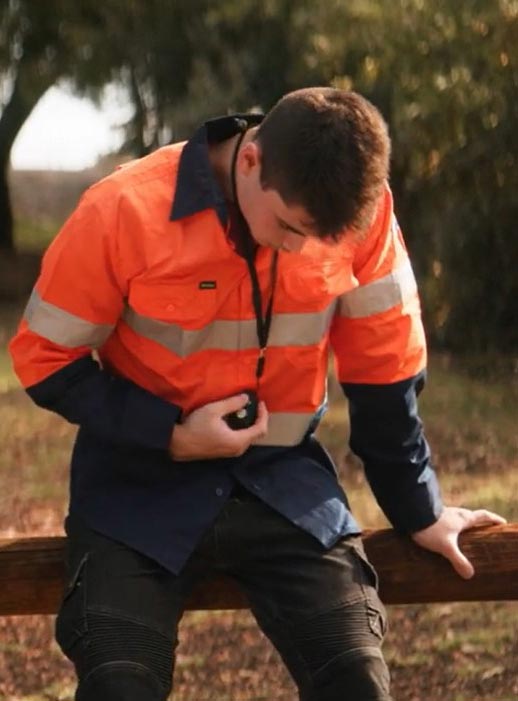
The pendant is the usual choice for most roles. It clips to a belt, sits on a lanyard or attaches to a keyring, and can be worn under high-visibility clothing without getting in the way.

The watch suits workers who would rather not carry anything extra, and has an interchangeable lockable wristband so it stays on. Both have the same features, the same monitoring and the same price.

Not sure which suits your team? We will bring both to the demonstration and let them decide.

Rolling out across a team

Most of our customers start with a handful of devices and expand. Here is what that looks like in practice.

Start where the risk is

You do not have to equip everyone at once. Most organisations begin with the roles their risk assessment flags first — night shift, sole-charge sites, home visits, remote crews — and add devices as the rollout proves itself.

One account, protocols you define

However many devices you run, you have one monitoring account with us. You set the escalation protocol, and you can set it differently by team, site or shift: who we call first, who we call next, when we go straight to emergency services.

Nothing to integrate

Devices arrive configured and ready. There is no software to install, no IT project, no integration with your systems. Hand the device to the worker and it is live.

Evidence for your audit

Every activation is logged with time, location and the action taken. That record is what turns a control into documented evidence when your regulator, your insurer or your client asks how you manage isolated work.

Volume terms

Pricing is per worker per month, and we work with organisations from a few devices to several hundred. If you are equipping a team, talk to us about volume terms rather than working off the single-device price below.

One point of contact

You deal with our West Perth team — the same people who run the Monitoring Centre. Not an interstate account manager and not a reseller.

Equipping a team? Call (08) 9427 4800 and ask for a volume quote and an onsite demonstration. We will bring devices for your team to handle.

solosafe Pricing

From $30 a monthper worker, for 24/7 professional monitoring

That is the ongoing cost per worker — Police licensed operators in our ASIAL Grade A1 Monitoring Centre in West Perth, ready to answer at any hour. Option 1 has no minimum term.

Choose the option that suitsDevice, one-off costMonitoring, per worker per month
Option 1 — buy the devicesNo minimum term, cancel any time$199 each$30
Option 2 — no upfront cost12-month minimum termNothing to pay$35

All prices include GST. Pricing shown applies to Western Australia and to single devices — ask us about volume terms if you are equipping a team.

ASIAL Grade A1 Monitoring Centre, West Perth | Police Licensed Operators | ISO Certified | Operating to AS 2201.2:2022

Who counts as a lone worker

More people than most organisations assume. If someone is isolated from assistance at any point in a shift — because of where they are, what time it is, or the nature of the task — they are a lone worker under the Regulations.

  • Night, weekend and early-morning staff
  • Doctors, nurses, midwives, carers and mental health workers
  • Community, disability and in-home support workers
  • Paramedics, first responders and caretakers
  • Cleaners, maintenance and trade workers
  • Real estate agents and property managers at open homes and inspections
  • Drivers, delivery people, meter readers and factory workers
  • Retail staff opening or closing on their own
  • Field crews in remote and regional WA
  • Anyone working in a hazardous occupation without a second person present

solosafe or StaySafe?

We offer two lone worker solutions. The difference is whether your people carry a dedicated device or use the phone they already have.

solosafeStaySafe
What it isA dedicated pendant or watchAn app on the worker’s phone
Best forHigher-risk roles, hands-busy work, aggression riskLower-risk roles and larger, cost-sensitive rollouts
Fall detectionYes, on the deviceDepends on the handset
Discreet activationOne button, worn under clothingRequires unlocking a phone

See StaySafe, or call and we will talk through which fits your risk profile — plenty of organisations run both.

Frequently asked questions

What does the law actually require us to do?

Under the Work Health and Safety Act 2020 (WA) you must ensure workers’ health and safety so far as is reasonably practicable. The WHS (General) Regulations 2022 (WA) require you to manage the risks of remote or isolated work and to provide a system of work that includes effective communication with the worker.

No regulation names a specific product. What is required is that you assess the risk, control it proportionately and document what you did. A monitored duress device is a common control where a risk assessment identifies aggression, remoteness or medical risk.

This is general information, not legal advice — your obligations depend on your operations.

What happens when a worker presses the button?

The alarm reaches our Monitoring Centre in West Perth and a Police licensed operator speaks to the worker through the device. They assess what is happening and follow the escalation protocol you have set — your nominated contacts, your on-call roster, or Police and Ambulance. The operator stays with it until the situation is resolved.

How is this different from an app on the worker's phone?

An app needs the worker to unlock a phone, and it usually alerts a manager who may be off shift. solosafe is a single button, worn under clothing or on a belt, and it reaches a trained operator who is on duty 24 hours a day.

For lower-risk roles an app can be the right answer — see StaySafe. For roles where the risk assessment flags aggression, remoteness or medical risk, a dedicated monitored device is the stronger control.

Can we set different escalation for different teams or sites?

Yes. You have one monitoring account regardless of how many devices you run, and escalation protocols can be set differently by team, site or shift — including who we contact first, who we contact next, and when we go straight to emergency services.

What does it cost to equip a team?

The single-device price is $199 upfront plus $30 per worker per month, or nothing upfront and $35 per worker per month on a 12-month term. Both include GST.

If you are equipping a team, call us on (08) 9427 4800 for volume terms rather than working from the single-device price.

Is there a minimum number of devices?

No. Most organisations start with the roles their risk assessment flags first and expand as the rollout proves itself.

How long does deployment take?

Devices arrive configured and ready to use. There is no software to install and no integration with your systems — hand the device to the worker and it is live. Setting up your escalation protocols is a conversation with our team, not a project.

Does it work in remote WA, or underground?

solosafe uses an inbuilt SIM on the Telstra network, so it works anywhere with Telstra mobile coverage — which is the widest coverage in Australia, but not everywhere.

Where there is no mobile coverage at all, no mobile-network device can transmit, including this one. If you have crews working genuinely out of coverage, or underground, tell us where and we will be straight with you about what will and will not work there.

Can we trial it first?

We offer an obligation-free demonstration and will come to you with devices for your team to handle. Call (08) 9427 4800 to arrange one.

Need to know more?

Call (08) 9427 4800, or fill in the form below and our West Perth team will get back to you.

solosafe is also used for independent living and home care.

This field is for validation purposes and should be left unchanged.
This helps us quote accurately — an estimate is fine.
Demonstration
For example the roles involved, or what prompted you to look into this.

———- END PAGE CODE ———-